01
Where it fits and where it does not
Use these four checks before committing implementation time.
- Use it when
- Objectives, endpoints, eligibility, interventions, schedules, and other protocol facts must stay consistent across authoring, registry, study-build, and downstream systems.
- Limits
- Do not use USDM as an electronic data-capture system, a submission dataset, or proof that generated documents satisfy every regulator. It supports those outputs; it does not replace them.
- Best for
- Study designers, clinical data standards teams, protocol authors, digital-protocol product owners, and integration architects.
- Maturity
- ScalingUSDM v4.0 is released with an implementation guide, API, terminology, and conformance rules; adoption and end-to-end tooling are still scaling.
02
See it in the workflow
This view shows the input, the change the standard introduces, and the resulting output.
- InputWhat starts
Protocol intent: objectives, endpoints, eligibility, interventions, schedule of activities, estimands, amendments, and controlled terms
- USDMWhat changes
USDM v4.0 organizes that intent as a versioned, computable study definition
- OutputWhat becomes possible
Consistent protocol content, registry fields, CTMS/EDC setup inputs, and SDTM Trial Design metadata
03
A concrete example
A sponsor authors one versioned study definition, then reuses it to initialize protocol text, registry fields, clinical trial management and electronic data-capture configuration, and SDTM Trial Design metadata.
Why it matters: Structured protocol intent is valuable for agents and automation, but generated study assets still require conformance checks and accountable clinical review.
04
What it fits with
Aligns with ICH M11 and CDISC Biomedical Concepts, controlled terminology, and SDTM Trial Design; its API can bridge to FHIR-facing systems.
- StandardCDISC
USDM structures upstream study intent; CDISC foundational standards carry acquisition, tabulation, analysis, and submission data downstream.
Explore relationship - Data model / schemaCDISC BCs
CDISC Biomedical Concepts provide reusable clinical concepts that can help keep protocol intent and downstream data structures aligned.
Explore relationship - StandardCDISC ODM
USDM describes the study definition; ODM exchanges operational study metadata and subject data for EDC and archive workflows.
Explore relationship - StandardFHIR®
A USDM API can connect protocol intent to FHIR-facing systems, while FHIR handles operational healthcare exchange.
Explore relationship
05
Implementation starter
Start with one bounded handoff. Pin, test, and review it before scaling.
Choose one study and name the downstream outputs that will consume the definition.
Pin USDM v4.0 together with the implementation guide, API schema, controlled terminology, conformance rules, and tracked errata.
Map the current protocol-authoring concepts and identifiers into USDM without discarding the source representation.
Generate one representative protocol section, registry extract, and study-system handoff from the same versioned definition.
Validate the model and each downstream artifact, then reconcile changes back to the authoritative definition.
Assign clinical, standards, regulatory, and technical owners for review, release, and amendment handling.
06
Test the main limitation
The model, API, terminology, conformance rules, or downstream mappings drift onto incompatible versions.
Record every dependency in a release manifest and run the pinned conformance suite plus representative downstream transformations before each promotion.
Generated protocol or system artifacts look plausible but alter clinical intent or omit regulator-specific requirements.
Diff each generated artifact against the authoritative definition and require accountable clinical and regulatory sign-off on meaning, completeness, and jurisdictional requirements.
07
Official resources
Specifications, diagrams, examples, and guides from the organizations that maintain them.
Digital Data Flow and USDM versions
CDISC's canonical overview of USDM, its releases, implementation guidance, and related Digital Data Flow work.
- Publisher
- CDISC
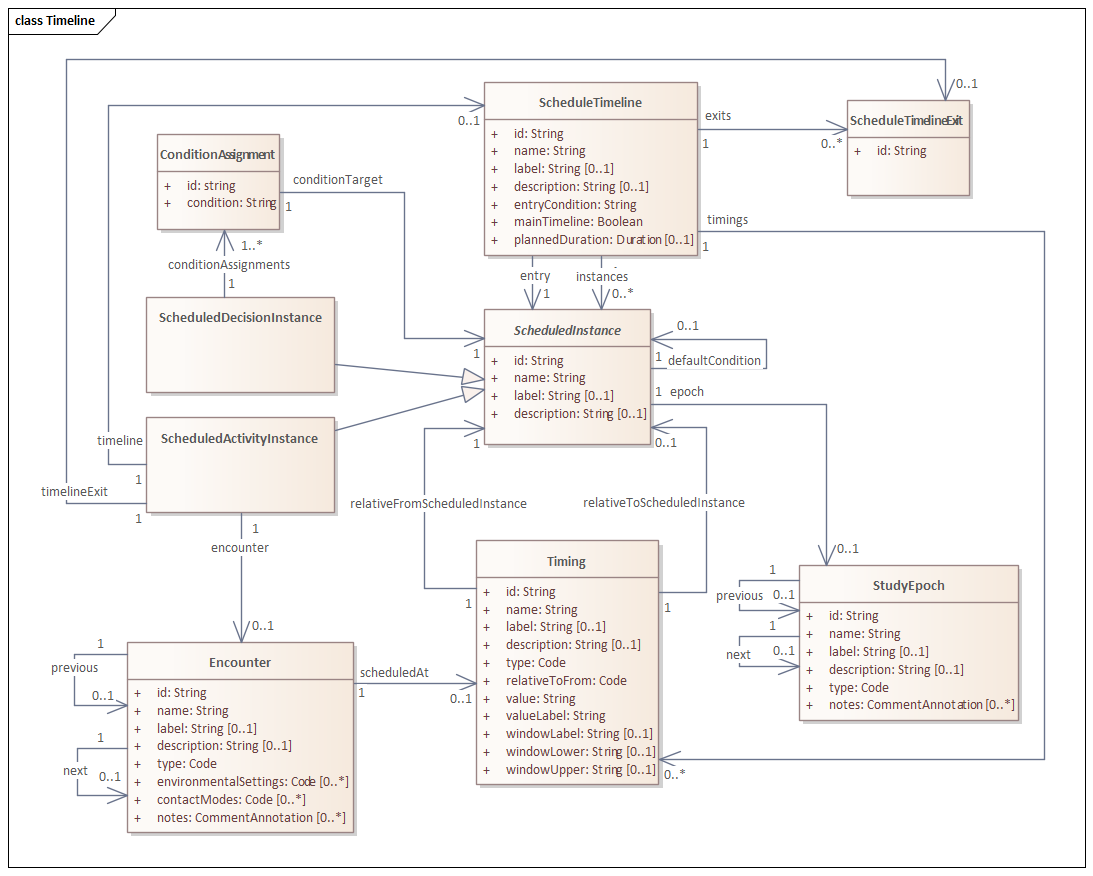
DDF-RA timeline UML view
A version-pinned model view showing how study timeline concepts relate inside the DDF reference architecture.
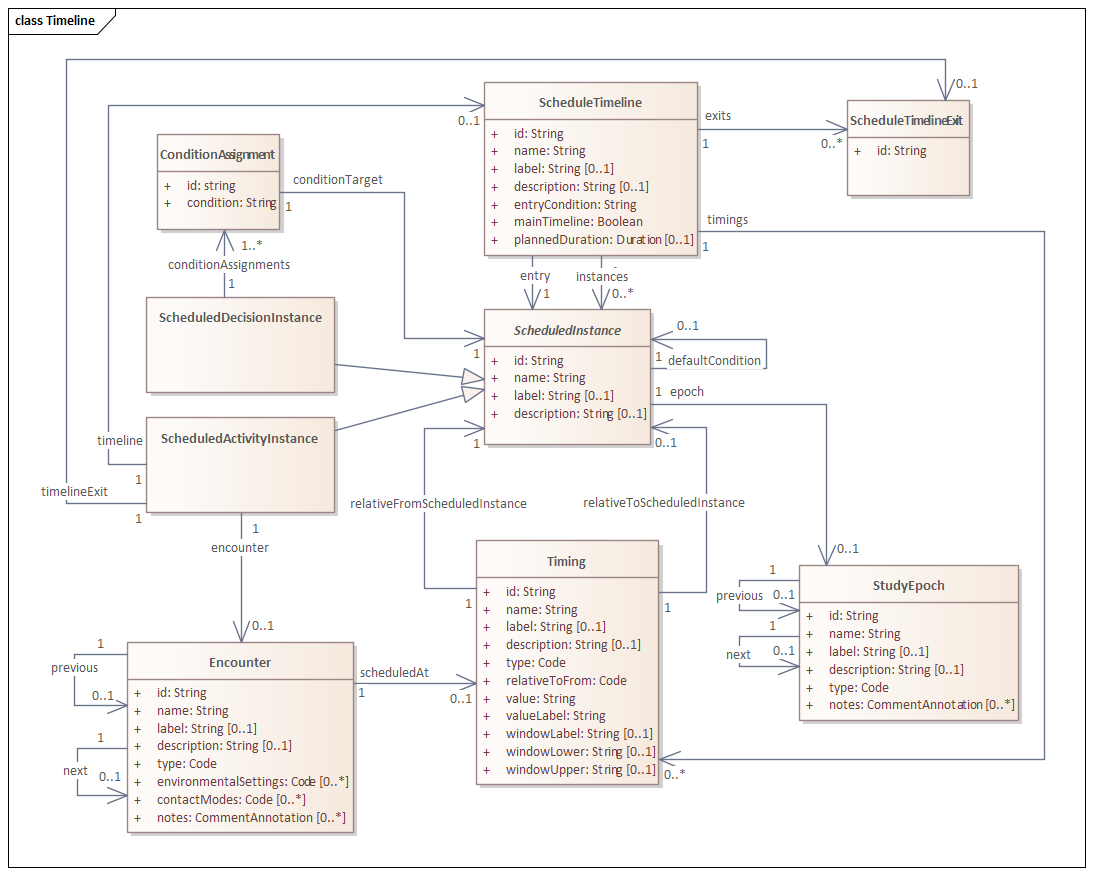
CDISC DDF-RA v4.0.0, Timeline UML view, CC BY 4.0Preview · open the original at the publisher - Publisher
- CDISC DDF-RA project
USDM OpenAPI specification
The version-pinned API contract for exploring resources, operations, and implementation details.
- Publisher
- CDISC DDF-RA project
Official USDM examples
Version-pinned example artifacts for seeing how the reference architecture is represented in practice.
- Publisher
- CDISC DDF-RA project
Advancing the Schedule of Activities using USDM
A CDISC-hosted webinar page explaining the Schedule of Activities work and its relationship to USDM.
- Publisher
- CDISC