01
Where it fits and where it does not
Use these four checks before committing implementation time.
- Use it when
- You need an operational exchange boundary between healthcare systems, an eSource feed, a registry interface, or a clinical-research integration built against a named implementation guide.
- Limits
- Do not use base FHIR conformance as proof of conformance to a research implementation guide, and do not treat FHIR as an analysis-ready warehouse or submission dataset.
- Best for
- Interoperability architects, clinical informaticians, integration engineers, and research teams bringing EHR data into a governed workflow.
- Maturity
- EstablishedFHIR R5 is established as an exchange standard, but R5 is a Standards for Trial Use release and maturity varies by resource, package, and implementation guide.
02
See it in the workflow
This view shows the input, the change the standard introduces, and the resulting output.
- InputWhat starts
EHR facts such as Patient, Observation, Medication, and Specimen records plus their local codes and provenance
- FHIR®What changes
A named FHIR release, implementation guide, profiles, terminology bindings, and API contract
- OutputWhat becomes possible
Validated resources that another authorized system can request, interpret, and trace
03
A concrete example
An eSource service requests Patient, Observation, Medication, and Specimen resources from an electronic health record, validates them against a pinned research profile, and preserves identifiers and provenance for study review.
Why it matters: Machine-readable resources accelerate ingestion, but analytical features still need cohort, temporal, and terminology normalization.
04
What it fits with
Profiles constrain resources; ConceptMap bridges terminologies; implementation guides connect FHIR to OMOP and CDISC use cases.
- Data model / schemaOMOP CDM
FHIR commonly carries operational health data into an ETL process; OMOP reshapes it for longitudinal observational analysis.
Explore relationship - StandardCDISC
FHIR can support eSource exchange, while CDISC standards structure regulated study acquisition, analysis, and submission artifacts.
Explore relationship - TerminologyLOINC
FHIR terminology bindings often use LOINC to identify laboratory tests, observations, and clinical measurements.
Explore relationship - Metadata profileVulcan RWD IG
The Vulcan Real World Data implementation guide applies FHIR profiles to a specific clinical-research use case.
Explore relationship
05
Implementation starter
Start with one bounded handoff. Pin, test, and review it before scaling.
Define one exchange use case and the receiving system's decision before selecting resources.
Choose a named implementation guide; pin the FHIR release plus package and terminology versions.
Select the required resources, profiles, search parameters, extensions, and terminology bindings.
Validate representative examples with the target profile package and test them against the real server contract.
Test authorization, consent, provenance, error handling, and reconciliation as separate operational requirements.
If the data feeds analytics, measure what is lost or transformed when it enters the analytical model.
06
Test the main limitation
A payload passes base FHIR validation but fails the named implementation guide or the receiver's contract.
Run profile-specific validation and a round-trip test against the target server using representative extensions, codes, references, and failure cases.
FHIR resources arrive successfully but cannot support the intended cohort, endpoint, or temporal analysis.
Trace one real analytical question from source record through the FHIR exchange into the downstream model, measuring missing codes, time context, provenance, and cardinality changes.
07
Official resources
Specifications, diagrams, examples, and guides from the organizations that maintain them.
HL7® FHIR® R5 specification
The canonical R5 specification and entry point to resources, infrastructure, and implementation guidance.
- Publisher
- HL7
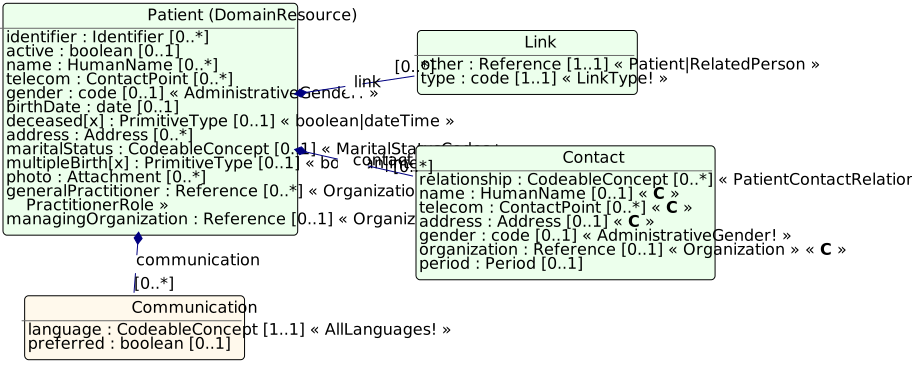
Patient resource visual
The official visual overview of the Patient resource and its most important relationships.
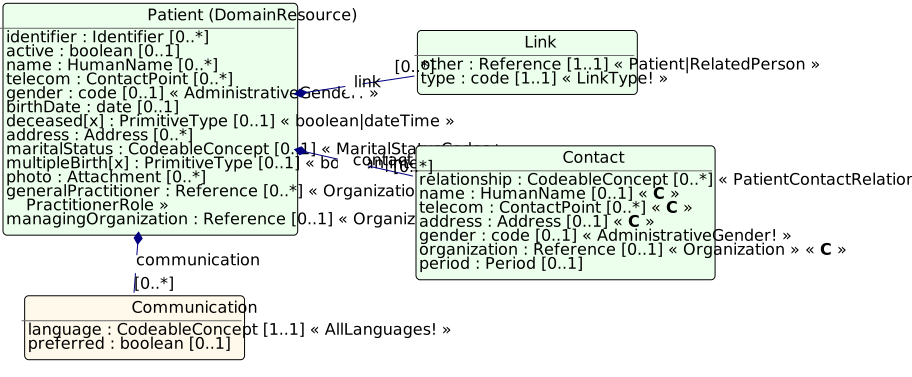
HL7® FHIR® R5 Patient resourcePreview · open the original at the publisher - Publisher
- HL7
Patient resource specification
Definitions, scope, boundaries, fields, examples, and maturity details for Patient in R5.
- Publisher
- HL7
R5 downloads and implementation artifacts
Official definitions, schemas, examples, packages, and publication downloads for implementers.
- Publisher
- HL7