01
Where it fits and where it does not
Use these four checks before committing implementation time.
- Use it when
- You need a shared outcome framework for designing, procuring, releasing, or improving a data product across its lifecycle.
- Limits
- Do not use FAIR as a technical architecture, a universal quality score, or proof that data is scientifically valid, representative, lawful, or ready for AI.
- Best for
- Data product owners, stewards, repository teams, and funders who need a common definition of responsible reuse.
- Maturity
- EstablishedThe principles are established and widely referenced, but FAIR has no single conformance specification. State which assessment method you use.
02
See it in the workflow
This view shows the input, the change the standard introduces, and the resulting output.
- InputWhat starts
A dataset plus its metadata, identifiers, access conditions, provenance, and domain context
- FAIRWhat changes
Improve its Findable, Accessible, Interoperable, and Reusable behavior
- OutputWhat becomes possible
A data product that people and machines can discover, understand, access under stated conditions, and reuse
03
A concrete example
Before releasing a multi-omics study, its data product owner assigns persistent identifiers, publishes searchable metadata, records access and license conditions, uses domain ontologies, and preserves sample-to-file provenance.
Why it matters: Machine-actionability is central, but FAIR alone does not guarantee statistical quality, representativeness, or model fitness.
04
What it fits with
Realized through persistent identifiers, DCAT/Bioschemas, domain ontologies, provenance, and community standards.
- Metadata vocabularyDCAT 3
DCAT supplies a catalog vocabulary that can make data and services more findable and accessible.
Explore relationship - Ontology / data modelPROV-O
PROV-O supplies a concrete vocabulary for the provenance that supports reuse and trust.
Explore relationship - Metadata profileBioschemas
Bioschemas makes life-science resources more discoverable on the Web with structured metadata.
Explore relationship - Data model / schemaRO-Crate
RO-Crate packages data, metadata, identifiers, and provenance into a portable research object.
Explore relationship
05
Implementation starter
Start with one bounded handoff. Pin, test, and review it before scaling.
Name the people and software that should find and reuse the data, and the decision that reuse must support.
Assign globally unique, persistent identifiers to the data and its metadata.
Publish rich, machine-readable metadata even when the data itself requires controlled access.
Use domain standards and governed vocabularies instead of inventing local labels where practical.
Record provenance, license, access conditions, version, and a durable stewardship owner.
Assess the result with a named method, publish the gaps, and keep FAIR distinct from scientific-quality and AI-fitness checks.
06
Test the main limitation
FAIR becomes a badge while identifiers, metadata, or access instructions remain incomplete.
Ask a reader outside the producing team to discover the release, resolve its identifiers, interpret its metadata, and follow its stated access path without private guidance.
A highly FAIR dataset is still biased, poorly measured, or unsafe for the intended analysis.
Run separate scientific-quality, representativeness, privacy, leakage, and intended-use reviews; FAIR evidence does not replace them.
07
Official resources
Specifications, diagrams, examples, and guides from the organizations that maintain them.
FAIR Guiding Principles
The canonical overview of Findable, Accessible, Interoperable, and Reusable data behavior.
- Publisher
- GO FAIR
The FAIRification process
A practical workflow for moving from raw data through analysis, semantic modeling, linkage, and publication.
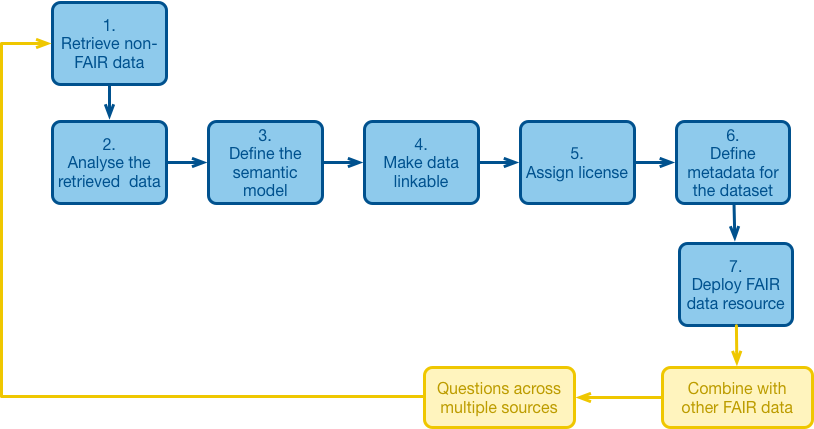
GO FAIR, The FAIRification ProcessPreview · open the original at the publisher - Publisher
- GO FAIR
GO FAIR media collection
Official talks and explainers for readers who prefer a guided introduction to FAIR concepts.
- Publisher
- GO FAIR